

The past two weeks of Iran coverage have brought us a haze of suspiciously confident Twitter threads, contradictory Trump explanations, and hourly screenshots of oil futures. In this environment, I’m not quite stupid enough to inject any definitive predictions of my own. I do, however, think it would be useful to zoom out and consider all this news in a broader context—and we can start with the last time we all endured weeks of suspiciously confident Twitter threads, contradictory Trump explanations, and hourly screenshots of asset prices.
The Chinese Century, One Year Later
There’s been a good amount of bickering online about whether this war is all about weakening China, has nothing to do with China, or in fact strengthens China. We’ll get there. First, I’d like to take a moment to remember a month of op-eds and podcasts about the Chinese Century.
This was last spring. Tariffs were top of mind at that point, while the Trump Administration was doing battle with various aspects of the higher education system and slashing public research funding, all of which became foundational to mainstream arguments that the U.S. was ceding the future to its greatest geopolitical adversary
An example of the form, from the New York Times in May:
For years, theorists have posited the onset of a “Chinese century”: a world in which China finally harnesses its vast economic and technological potential to surpass the United States and reorient global power around a pole that runs through Beijing.
That century may already have dawned, and when historians look back they may very well pinpoint the early months of President Trump’s second term as the watershed moment when China pulled away and left the United States behind.
… Mr. Trump is taking a wrecking ball to the pillars of American power and innovation. His tariffs are endangering U.S. companies’ access to global markets and supply chains. He is slashing public research funding and gutting our universities, pushing talented researchers to consider leaving for other countries. He wants to roll back programs for technologies like clean energy and semiconductor manufacturing and is wiping out American soft power in large swaths of the globe.
Citing the astounding and ever-expanding manufacturing footprint of China, as well as the more recent success of DeepSeek, that op-ed concluded by arguing the U.S. should be “forging economic ties with countries around the world” and “creating a welcoming and attractive climate for international talent and capital,” while chiding Trump for “a shortsighted focus on inconsequential skirmishes as the larger war with China is being decisively lost.”
The headline on that piece—“In the Future, China Will Be Dominant. The U.S. Will Be Irrelevant.”—was particularly spicy and not the author’s fault, but it was very much a product of its time (i.e., 10 months ago). Elsewhere, there were plenty of other op-eds echoing those sentiments, in both the NYT and Washington Post, while Derek Thompson at the Ringer released a podcast episode explicitly asking, “Is This the Chinese Century?” That conversation focused on tariffs and their potential to alienate allies, the erosion of U.S. manufacturing capacity, and the expertise of two Biden National Security Council staffers who warned, “We could be behind China technologically. We could be dependent on China economically. We could be defeated by China militarily.”
I found most of this discussion to be fairly ridiculous, and said as much on Sharp China last year. The problem I had was not with the framing of the stakes for the future, but the misleading, melodramatic view of the scoreboard in the meantime. For one thing, all the anxiety surrounding America’s relationships with allies seemed to overlook that China’s only economically or geopolitically relevant allies, in the entire world, were deeply paranoid and self-interested authoritarian governments in Iran, North Korea and Russia.
For another, any argument that America is, was or will be destroying its capacity to innovate is a claim that needs more evidence. DeepSeek’s breakthrough V3 model, for example, was trained on American chips and distilled American AI models, while the entire AI era in both countries is the product of the transformer architecture and research that was undertaken by Google, not American universities. Beyond that, Tesla effectively invented the EV consumer category. Apple did the same for smartphones. Nvidia remains dominant in GPU chips and is the most valuable company in the world. America has invented, and then dominated, every new industry of the past 30 years.
More broadly, the idea that the U.S. under Trump has become less attractive for global researchers, founders and innovators of the future is maybe technically true relative to previous generations, but that insight is functionally irrelevant. A slightly less attractive America is still galaxies more attractive than the EU’s lack of capital and crushing tax regimes or China’s repressive society and lack of legal protections. (One reason America does not currently have even more Chinese talent working in its AI labs is because top AI researchers have had their passports confiscated.)
Most importantly, 10 months later now, it’s simply not credible to claim that the future is being handed to China. Maybe it will be, maybe it won’t, but any sort of fatalism rings especially hollow to anyone who’s been following the news. It’s America who is acting all over the world, reordering global trade, forging more useful allied relationships, removing Chinese leverage throughout the Western Hemisphere, and working to acquire new leverage of its own. China, in turn, is holding press conferences to say, “Our enemies are not each other—they are war, poverty, hunger, and injustice.”
What China Has at Stake in Iran
So is the war in Iran “all about China,” as some have argued? While I enjoyed the inciting piece and the Internet’s subsequent arguments over this point, I don’t think it’s productive to characterize the war that way, in part because that framing demands some obvious and correct pushback. Iran has been killing Americans and interfering with regional security while subjugating its own people for nearly 50 years; there are lots of good reasons to attack an evil Iran regime that’s in a weakened state, particularly as it seeks to stockpile ballistic missiles and rebuild its nuclear program, thereby positioning itself to harass the U.S. and its allies indefinitely. Furthermore, any argument that the war is “all about China” invites the inevitable “well, actually” to point out that China will survive just fine regardless of what happens in Iran. That’s true, too.
The Trump Administration, for its part, has offered terrifically chaotic messaging on a daily basis since the war began. There are constantly evolving explanations for how long the war will last, as well as a maddeningly inconsistent list of explanations for why we are at war in the first place (and whether this should be characterized as a war). They are basically flooding the zone, which may in fact have some strategic benefit, but may also just be how the current Administration approaches both bureaucratic process and the media.
One explanation never proffered by the Administration, though—not even once—is anything related to the strategic value of this war’s impact on China. When asked late last week whether the U.S. had a message to China and Russia, Pete Hegseth said, “They are not really a factor here.”
That Hegseth exchange was seized upon by many in the media and D.C. think tank community who were tired of hearing strangers on the internet argue that one of the primary American interests being advanced in Iran is the ability to impose a strategic setback on China. Aha!, the think tankers said, it’s not about China and they are not a factor here, and in fact, Iran is not strategically meaningful to China.
Here is where I draw the line on indulging those who insist there’s no China angle, for two reasons. First, if the war in Iran were a response to China, on any level, there would be no strategic benefit to announcing that aspect of the operation to the entire world, and specifically to China. What is Hegseth supposed to say? “Our message to China is that we intend to win this war, secure the Strait of Hormuz, and retain the ability to shut off about 50% of Chinese oil imports in the event of any kinetic conflict around Taiwan”? Would that messaging hurt or help American interests?
Second, even after we stipulate that public statements should not be considered dispositive of the China question, the question itself is sort of a pedantic red herring. Whether undermining Chinese interests is or isn’t a primary motivation of the Administration, what matters is the obvious reality: this war does undermine Chinese interests. In lots of ways!
In 2021, China announced a 25-year comprehensive strategic partnership that promised deepened economic, military and security cooperation with Iran, and which included $400 million in infrastructure commitments from China. Iran was welcomed into the Shanghai Cooperation Organization in 2023, and BRICS in 2024. China regularly backed Iran at the UN, where the latter enjoyed a seat on the Human Rights Council.
Beyond optics and inclusion in China-dominated institutions, Iran was a market for Huawei consumer goods and infrastructure, Iran sold 90% of its oil to China at a steep discount, and in exchange received both an economic lifeline and military support as it defiantly waged war with the West and sponsored terror all over the Middle East. Last January, the Financial Times reported that Chinese vessels set sail for Iran carrying “1,000 tonnes of sodium perchlorate, which is used to make ammonium perchlorate, the main ingredient for solid propellant for missiles.” Last June, the Wall Street Journal reported that Iran “ordered thousands of tons of ballistic-missile ingredients from China.” Days prior to Operation Epic Fury, Reuters reported that Iran was nearing a deal with China to buy supersonic anti-ship ballistic missiles. On Thursday this week, Fortune reported that a 79 year-old Chinese man and 38 year-old Chinese woman used Binance to transfer around $600 million in crypto assets to wallets linked to sanctioned IRGC actors and Houthi rebels.
Contrary to what some have argued recently, Iran was never merely an economic partner to whom China was indifferent. Sure, China is ultimately indifferent to every country that’s not China, but the CCP actively sponsored the Iranian regime’s military buildup and in turn its support of terror in the region, and in return Iran provided a symbol of successful Western defiance and a beachhead in the second most sensitive and economically significant trading zone in the world, where China could use proxies to harass America and its allies and exhaust time and money that might otherwise be spent focusing on the Pacific. In the event of a Taiwan war, Iran may well have proven very useful. All of that is now history.
Compounding matters, the optics of this are horrible for China. Their diplomats are now pleading with Iran to stop attacking important Chinese economic partners in the region. Regardless of what happens next, their “comprehensive strategic partnership” was revealed as worthless in front of the whole world, as China refused to offer any material support to the Iranian regime over the past two weeks. The weapons systems that were sold to Iran were evidently useless in the face of the Israeli and United States military tech, and to the extent Iran’s authoritarian regime is itself in jeopardy, that will be a very sensitive issue for leaders in Zhongnanhai whose greatest fear is political instability and whose greatest priority, even now, remains managing the flow of information and controlling public opinion to convince Chinese citizens that there is no alternative to the CCP. “The East is rising and the West is declining” has been a go-to Xi Jinping line for years, but some Chinese political scientists are now openly concluding the opposite: “[I]n reality, the US retains formidable economic strength and possesses unparalleled military power globally.”
Finally, there’s the Strait of Hormuz. In January, the U.S. installed a friendly leader in Venezuela who now affords the U.S. the ability to shut off oil shipments to China in the event of any war scenario surrounding Taiwan. If the U.S. were able to do the same in Iran, it would vest the U.S. with the power to shut off 17% of China’s oil imports. Of course, China is also Saudi Arabia’s biggest oil customer, and Oman’s, and Iraq’s, and all of that oil also passes through the Strait of Hormuz. In total, 40–50% of China’s oil imports pass through the Strait of Hormuz, in addition to various petrochemicals that are critical to Chinese industry and agriculture. If the U.S. is able to work with regional partners to first secure the strait, and then to secure control over what passes through the strait, it will gain the ability to impair wide swaths of China’s economy. This is admittedly an extremely tall order with a multitude of variables, and here I’ll return to my promise at the beginning to not offer stupid predictions. If the U.S. can pull that off, though, what’s currently a strategic setback for Beijing would become something a bit more dramatic. Indeed, gaining control over the Hormuz chokepoint appears to be a goal, and would be perhaps the most effective deterrent to war (or economic war) the U.S. has.
That brings us back to Trump and the media. Earlier this week, Trump was asked about the Strait of Hormuz and said, “I want to keep it open. I want to keep it good. You know, it doesn’t pertain to us so much as it does to China. We’re really helping China here. And other countries. Because they get a lot of their energy from the strait. But hey, look, we have a good relationship with China. It’s my honor to do it.”
Responding to that moment, in which Trump tells China that it’s his honor to help protect their short term economic future, a New York Times Diplomatic Correspondent concluded, “So much for pundits who said the Iran War is about weakening China. The US might be heading back to a pre-2016 China policy.”
With all due respect to that reporter’s interpretation and of course to President Trump’s sincerity… I’m not sure that’s how the Chinese side interpreted that message.
The Reality of Pivoting to Asia
The Obama Administration first announced a “pivot to Asia” in 2011, and in 2025 there was a book published about the success of these American efforts, aptly titled, Lost Decade. Another book on the topic, The Strategy of Denial, came from current Under Secretary of War, Elbridge Colby, who argued that Asia is the most important geopolitical region in the world, it needs to be America’s top priority, and that in light of limited U.S. resources, attempting to police the world everywhere—in Europe, the Middle East, and Asia—dilutes deterrence anywhere.
Over the past two weeks, as the U.S. has burned through munitions and yes, diverted assets from Asia, I’ve seen people online delighting at Colby’s apparent marginalization and telling him he should resign. On the other hand, watching Colby in this sitdown with the Council on Foreign Relations, he didn’t seem at all dismayed with the current state of affairs with respect to China. This bit, in particular, jumped out:
“I think in the last administration, you had a very vocal [message] from the President who I think would make comments about the leadership of China, about very sensitive topics, in a way that would catalyze a massive reaction, but without delivering the strength. And so I think our approach is really the exact opposite, is to be calibrated and careful about what we say … And I’ll just say … I think we are absolutely focused on making sure the President has the capabilities to meet the standards set by the National Security Strategy, which is denying aggression along the first island chain.”
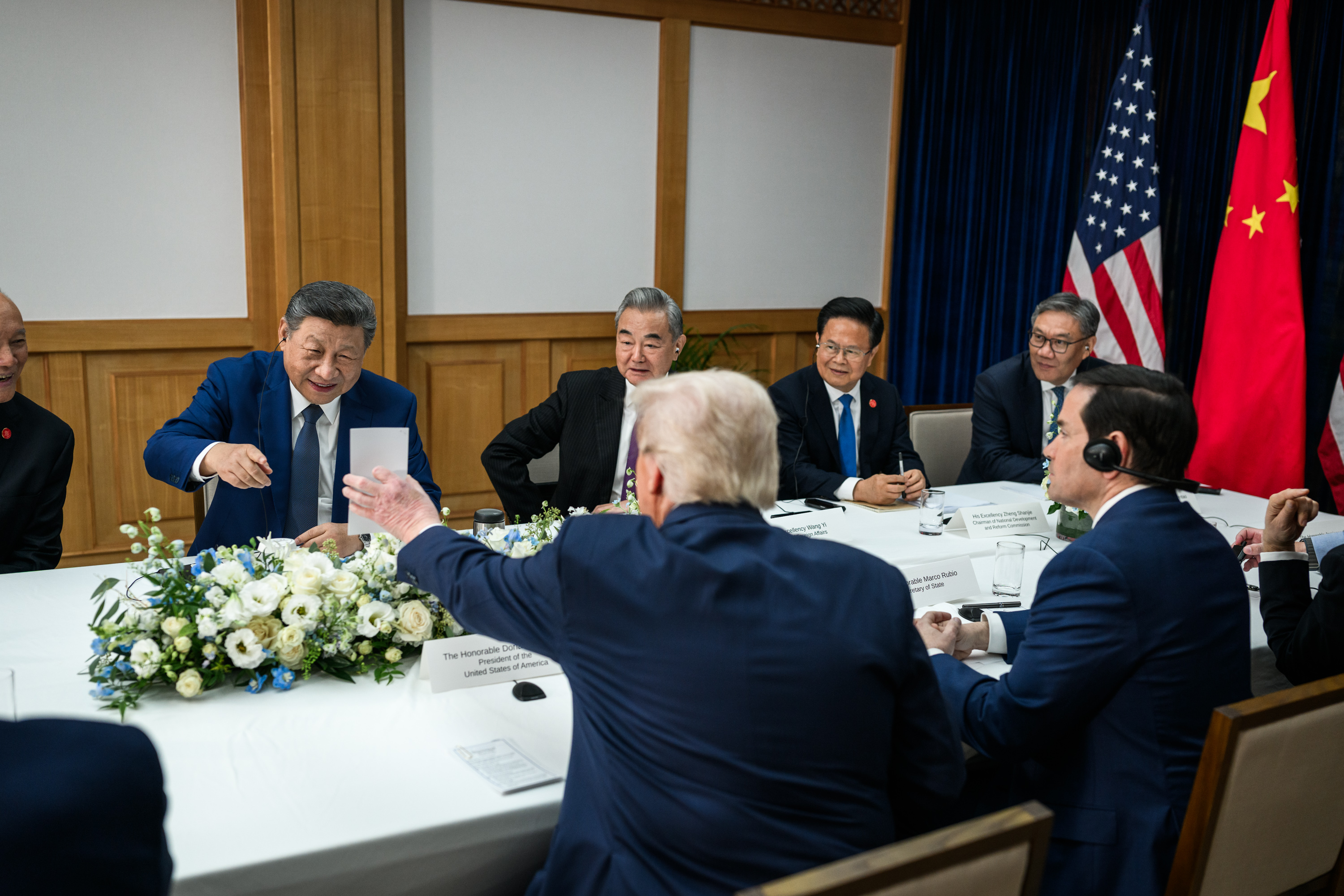
I’ve been watching Trump’s China policy closely for over a year now, and that Colby quote captures it well. Where Biden’s team would talk hawkishly about China and then do nothing to check Chinese aggression (hacking the State Department, the spy balloon, harassing the Philippines, intensified exercises around Taiwan, deepened ties with Iran and Russia), the Trump team is a near perfect inverse. Every Trump tweet about Xi is friendlier than the last (what were they laughing at here?), and an Administration not known for message discipline is exceptionally circumspect on all China questions. All while the U.S. is taking steps to bolster its security footing practically every week.
Consider what Trump inherited. One month before his second inauguration, China admitted to perpetrating widespread hacks of critical American infrastructure (“U.S. ports, water utilities, airports and other targets”). Prior to that disclosure going public, there was another hacking scandal that Senator Mark Warner called the “worst telecom hack in our nation’s history—by far.” These were meaningful acts of aggression and violations of American sovereignty, and yet there is only so much the U.S. could do to respond. China’s manufacturing capacity is a problem both economically and militarily, and there are supply chain dependencies throughout American industry; getting along to go along is in some cases our best bet. At the same time, though, it sure seems like the urgency of the problem has been increasing, and the Administration is convinced that China wants to invade Taiwan as soon as possible.
Against that backdrop, let me be clear that any strategic setbacks China experiences because of Iran will be manageable. No one’s predicting a collapse here. The PLA will learn from the U.S. military tactics on display this month, there is CCP propaganda value to any U.S. military adventure, and there are still a variety of scenarios in which this becomes an outright disaster for the Americans, to Beijing’s clear benefit. China also has the largest oil reserves in the world and would probably weather a prolonged energy shortage better than any of its regional peers. I’ll stop short of joining the galaxy brains arguing that gas and oil shortages would be strategically beneficial and could consolidate Chinese dominance in the electrostate era, but China will survive regardless.
The problem for anyone arguing this is no big deal for China and the CCP is that the war in Iran is not happening in isolation. This setback comes after a year of American tariffs on Chinese goods that did real damage to a shaky, debt-ridden economy and drove Xi Jinping to play the rare earths card in exchange for short term relief. Those tariffs are temporarily in flux, but the U.S. and its not-so-alienated allies are now working to solve the rare earths dependencies, while American trade barriers have sent China’s exports flooding to the rest of the world (up 21% through 2 months in 2026), particularly Europe (up 27.6%), and have rendered China’s beggar-thy-neighbor policies a problem in the eyes of institutions like the IMF that had previously spent decades looking the other way. The extent of global pressure that’s been applied to the CCP’s export-driven system, entirely initiated by the U.S., remains underappreciated, and the long-term consequences have yet to materialize.
On the security side, as the U.S. shores up vulnerabilities in Venezuela and Iran and decapitates China-aligned drug cartels in Mexico, it has done so while reestablishing a credible military deterrence, making clear to China and the whole world that U.S. military tech remains vastly superior, American security partnerships are valuable, and Trump is far more risk tolerant than his predecessors. Elsewhere, a China-allied government in Cuba is on the verge of collapse and with it will go Chinese spy stations, while a court in Panama—which hosted Marco Rubio’s first trip abroad as Secretary of State—recently expelled a Hong Kong shipping magnate from the Panama Canal. For anyone curious, you can read a great overview of China’s extensive investments in Panama and longstanding canal security concerns here; then once you’re done, recognize that similar Chinese tactics have been employed throughout Central and South America, and many of those decade-long influence and infrastructure projects are now similarly at risk—in Argentina, in Honduras, in Costa Rica, and beyond.
Perhaps there’s no unifying U.S. strategy to any of this and it’s all being done on a whim and Marco Rubio wound up in Panama by coincidence in the first month of the Trump presidency, but I think a careful study of the evidence reveals precisely the opposite. The U.S. is awake now, and countering malign Chinese influence is a consideration in almost everything the Administration does. The Trump team recognizes that Chinese threats have metastasized even since 2016, and they seem to have correctly concluded that the implication of China’s dominance as a geopolitical peer is that any attempt to secure supply chains and match Chinese scale with a military buildout of our own will take years, and require rebuilding muscle groups that have long since atrophied. Even if all that is done successfully, it might not be enough of a deterrent to win a war on the other side of the world that Xi Jinping sees as existential and the U.S. does not.
The goal, then, is to buy time to diversify supply chains away from China and attempt to deter any invasion scenario by applying pressure in more areas than just the South China Sea, making it clear to the CCP that there will be costs to Chinese aggression anywhere in the world. Rather than departing from strategic ambiguity and talking tough about every new round of Taiwan drills, Trump downplays that tension (“They’ve been doing naval exercises for 20 years in that area.”). At the same time, the U.S. is quietly selling at least $11 billion in arms to Taiwan and has spent the past year systematically, piece by piece, removing every point of leverage China has anywhere else in the world, and potentially acquiring additional new leverage of its own in the process. None of this is guaranteed to work, of course, but it’s a more proactive and clever foreign policy than the U.S. has employed in decades.
This is the story Trump critics have been missing since the spring of last year, when tariffs were going to ravage America’s global standing and we were all headed toward a Chinese Century. It’s not a complaint from me so much as an observation. The incentive structures of institutional media and D.C. think tanks make it very easy to amplify evidence of Trump dysfunction and very tempting to downplay American success, particularly if that success is defying conventional processes and international relations lessons that have animated American policy for the past 50 years. Trump makes it easy, too, with bombing hype videos from the White House X account and an official story that changes hourly.
Here again, though, adopting a different perspective may help. In the fog of information and a hundred different Trump answers, I imagine leaders in Beijing are far less confused than we are about what’s happened over the past 12 months and what it might mean.
Sharp Text is extension of the Stratechery Plus podcasts Sharp Tech, Greatest of All Talk, and Sharp China. We’ll publish once a week, on Fridays. To subscribe and receive weekly posts via email, click here.